Sunday, 31 January 2010

Amazing Spider-Man #12. Dr Octopus unmasks Spider-Man

Amazing Spider-Man #12, Dr Octopus unmasks Spider-Man
(Cover from May 1964.)

"Unmasked By Doctor Octopus!"

Written by Stan Lee.
Drawn by Steve Ditko.
Inked by Steve Ditko.
Lettered by Art Simek.


Expectations, according to that masterful master of words Charles Dickens, they can be great.

But we also know they can lead you astray or, worse than that, they can simply lead you nowhere. Take me. Some stories you find you have a whole kaboodle of things to say about, even when you wouldn't have thought you would, and some tales you find you have next to nothing to say about, even though you know you should.

Issue #12 of the Amazing Spider-Man falls into the latter camp. I mean, here's a tale to build epochs around, isn't it? Our hero's made it to his first dozen issues and we get to see Spider-Man unmasked by Dr Octopus.

So why then do I have so little to say about it?

Is it the artwork?

No.

Is it the writing?

No.

Is it the villain?

No.

Then what is it?

I don't know. Some critic I turned out to be.

So Spider-Man gets his first two parter as, having failed to capture Dr Octopus last time round, he gets another go at him.

And what a sad case Dr Octopus turns out to be, committing a string of crimes around the country purely to force Spider-Man to fight him, before returning to New York to kidnap Betty Brant purely to force Spider-Man to fight him. Not that he's obsessed or anything. But really, what does it say about a super villain when his only motivation for committing crimes is to pick a fight with his arch-enemy?

As with last issue, Spider-Man doesn't actually defeat Dr Octopus, he just gets lucky, which is a pleasing touch. It doesn't pay to make a super hero too successful against the opposition. After all, we might want him always to win but if he always triumphs no matter the odds, what happens to all the tension?

Highlight of the tale has to be Spider-Man and Doc Ock's fight in the sculptor's studio. It doesn't last long, thanks to Octopus getting himself trapped under a falling statue, but it's a pleasingly surreal venue for such a clash.

In fact, this issue's memorable for two things. One, Spider-Man gets to fight a bunch of animals Octopus has released from the zoo and, secondly, as touched on before, it's the tale where Spider-Man's true identity is at last revealed to the world, as, having defeated our flu-weakened hero, Dr Octopus pulls off his mask to reveal the face of Peter Parker beneath.

But there's the twist. No one believes Peter Parker could be Spider-Man and so, although people have seen his face, his identity remains a secret. It's those expectations again. If only Dr Octopus hadn't had expectations about how difficult to beat Spider-Man would be. If only J Jonah Jameson and Betty Brant hadn't had expectations about how puny Peter Parker is, his secret would be out. Maybe, from the viewpoint of our hero, sometimes false expectations are a whole lot better than great expectations.

Saturday, 30 January 2010

Amazing Spider-Man #11. Dr Octopus is back

Spider-Man cowers as Dr Octopus closes in on him, Amazing Spider-Man #11, Steve Ditko
(Cover from April 1964.)

"Turning Point"

Written by Stan Lee.
Drawn by Steve Ditko.
Inked by Steve Ditko.
Lettered by Sam Rosen.


Forget jet packs, ray guns and rocket ships, I sometimes think the invention we need most in this world is the robot from Lost in Space, the one that kept declaring, "Warning! Warning!" while waving its arms around. Certainly, the characters in The Amazing Spider-Man could do with it.

The judges and juries of Marvel Comics' New York city could definitely do with it. Only eight issues after being sent to jail for trying to take over the world - or something - Dr Octopus's sentence is served and he's free to go and look for alternative work. It's hardly surprising New York's crawling with crooks if sentencing in the city's this lax. Still, it does however mean Spider-Man's never short of someone to fight.

Another person in need of a good warning's Betty Brant who, in time-honoured tradition's done a runner. It seems her brother Bennett Brant has got himself mixed up with a crook called Blackie Gaxton who's blackmailing him into aiding his escape from prison. To do so, Gaxton's enlisted the aid of Dr Octopus and so, by the sort of coincidence that only happens in comic book land, Spider-Man's search for Dr Octopus and his search for Betty Brant lead him to the same place.

In fact, it's a slightly disappointing return for Octopus. Established as a major menace on his first appearance, here he's merely working as a lackey for someone we've never heard of before and, to my knowledge, never hear of again. Still, on the plus side, at the tale's climax, Spider-Man merely escapes Dr Octopus, rather than defeating him, thus preserving some of the not-so-good Doctor's menace.

In the first appearances index: we get the debut of the spider-tracer, although the idea that Spider-Man can detect it with his spider-sense has yet to be hit upon and so he uses a portable radio, hung around his neck, to detect it.

Steve Ditko's art goes from strength to strength. It may seem quite dated - and even quaint - these days but it has a simple elegance to it and it's quite surprising to see Betty Brant looking quite so glamorous.

As for Blackie Gaxton, he hangs around long enough to shoot dead Betty Brant's brother, making Betty the first of Peter Parker's girlfriends to lose a relative thanks to her involvement with Spider-Man's other half. Warnings again. If only she'd been able to warn Gwen Stacy what she was getting into. But hindsight, it's a wonderful thing.

Friday, 29 January 2010

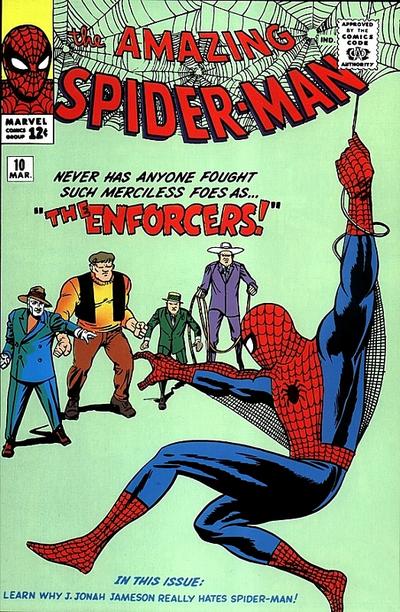
Amazing Spider-Man #10. The Enforcers

Amazing Spider-Man #10, Our hero squares up to the Enforcers first appearance
(Cover from March 1964.)

"The Enforcers!"

Written by Stan Lee.
Drawn by Steve Ditko.
Inked by Steve Ditko.
Lettered by Sam Rosen.


"With this classic tale, the Marvel Age of comics reaches a new plateau of greatness!" You have to hand it to Stan Lee, he's never believed in under-selling things, and he doesn't do so here.

But is he right? Does the Marvel Age of comics reach a new plateau of greatness with this issue?

Well, inevitably not. I've never heard this tale being referred to as the high watermark of Marvel Comics history, or even of that month - although it does set a few things up for the future, in that it introduces the Enforcers who, despite the build-up they're given, prove to be more an annoyance to Spider-Man than a threat. Even with him weakened by having given a blood transfusion, the Ox, Fancy Dan and Montana still can't do anything more than distract him for a short while.

The other thing the tale does is introduce would-be crime lord the Big Man, and also the reporter Frederick Foswell. As it turns out, the Big Man and Fred Foswell are the same person, which I suppose is obvious as we've never seen either of them before this issue.

Exactly why Foswell is the Big Man's a whole other matter. After all, why's a major crime lord working as J Jonah Jameson's doormat at the Daily Bugle? I suppose it could be put down as a cover. But then, I don't see the Kingpin working at McDonalds, or Kraven the Hunter busting his gut in Burger King.

Steve Ditko's art's superb in this issue, although his tendency to show Peter Parker with his face half Spider-Manned is over-used as we see the trick repeated in panel after panel.

But my big let-down of the tale arrives on the final page where we get J Jonah Jameson pontificating to himself as to why he hates Spider-Man. He declares it to be because he's jealous of a man who's clearly so much better than him. While it might be true that that's the reason for the antipathy, it doesn't feel right for him to be acknowledging it. Happily, I don't think this explanation - or its level of self-awareness - was ever displayed again. So, if we choose - and I do - we can brush it under the carpet and put it down as a rare lapse from Lee and Ditko.

My favourite moments of the tale actually come from Flash Thompson. It would've been easy for Lee and Ditko to have always portrayed him as nothing more than the school bully/loudmouth but, twice in this tale, Flash displays his more caring side, as he first visits Aunt May in hospital and then, later in the story, warns Peter Parker about the risk he's taking in telling everyone that he knows the Big Man's true identity. Needless to say, Peter Parker responds with sarcasm, which does start to give you insight into why Flash has a problem with him in the first place.

Can it be? Can it be that, all along, we've been on the wrong side and that, in the end, the attitude problem's been with Peter Parker and not with Flash Thompson?